CNC Drilling and Threading Machine for Pipe & Tube: Skip the Weld Nut, Keep the Strength
If your thin-wall tube parts still rely on welded nuts or inserts, you're paying for a workaround. CNC thermal flow drilling creates a thread-ready collar directly from the tube wall — drilled and tapped in one cycle with zero chips.
What "Drilling and Threading" Means for Thin-Wall Tube
A conventional process on pipe or tube runs: drill the hole → weld or press in a nut/insert → inspect the weld → deburr. A CNC drilling and threading machine replaces all of that with one operation: a rotating tool locally heats and displaces the tube wall to form a collar, then a tapping spindle threads that collar directly — drilling and threading (tapping) in a single station, no added part.
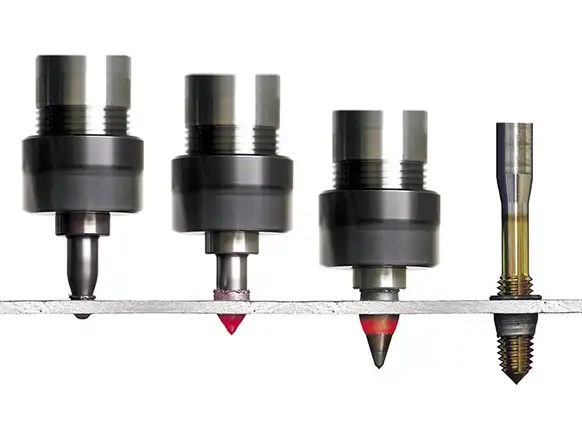
Wall Thickness Range for This CNC Machine
| Parameter / Type | Specification / Status |
|---|---|
| 0.5 – 10 mm | General drilling capability (mild steel baseline, diameter-dependent) |
| 0.8 – 4 mm | The range most pipe and tube parts actually fall into — auto frame tubing, HVAC ducting, furniture legs, bracket parts. This is the band Duomi's CNC drilling and tapping machines are tuned for. |
The friction tool locally forms a collar roughly 3× the original wall thickness. That collar is what actually gets tapped for threading — so a 1.5–3 mm tube wall behaves like a much thicker one once the hole is formed, giving the thread real material to bite into instead of two or three exposed thread turns.
Threading Strength: Flow-Formed vs Conventional Tapping
| Method | Strength & Performance |
|---|---|
| Flow-formed threading | ~8–12 kN |
| Conventional tapping directly into the bare 1.5 mm wall | ~2–4 kN |
Independent pull-out testing on a 1.5 mm stainless tube with an M6 thread: Roughly 3–4× stronger, purely from the longer thread engagement the collar provides. Flowdrill's own published engineering data goes further: a friction-drilled connection in 2 mm steel holds around 2.7 tons axially — stronger than an 8.8-grade bolted joint, and in the same class as a welded nut, without the weld.
Real Case: CNC Drilling, Tapping & Threading Upgrade for a Tier-1 Automotive Bracket Supplier in Pune, India
Customer: Confidential automotive component manufacturer, Pune, Maharashtra — Tier-1 supplier of mounting brackets and sheet-metal assemblies for passenger and commercial vehicle OEMs.
Part: Battery support bracket, 3.0 mm mild steel, two M8 threaded holes per piece, 35,000 pcs/month.
Before: Conventional Process
Laser/stamping → drilling → weld nut installation (2 nuts/pc) → weld inspection → surface treatment.
Machine Installed: DUOMI Solution
DHM-2030DT Thermal Form Drilling and Tapping Machine — a dual-spindle CNC unit where one spindle thermally drills the hole and forms the bushing/collar, and the second spindle taps the thread immediately after, both within a single clamping.

Annual savings after switching to CNC drilling and threading
| Metric | Before (Weld Nut) | After (Flow Drill) |
|---|---|---|
| Process | Drill → weld 2 nuts → inspect weld | Thermal drilling → tapping/threading, one clamping |
| Cycle time / piece | 61 sec | 22 sec |
| Output / shift | 590 pcs | 1,630 pcs |
| Operators / shift | 3 | 1 |
| Rejection rate | 2.8% | 0.6% |
| Item | Annual saving (USD) |
|---|---|
| Weld nut purchasing | ~$18,000 |
| Welding labor | ~$8,600 |
| Rework reduction | ~$12,000 |
| Fixture & consumables | ~$4,500 |
| Total Annual Savings | ≈ $43,000 / year |
Net result: 2.7× output per shift, 66% less manpower on this station, and roughly 28% lower cost per bracket — driven entirely by removing the weld-nut step and replacing it with one CNC drilling-and-tapping cycle. Thread consistency also improved, since there's no weld heat distortion pulling the hole out of position.
This case reflects representative production economics for this part type, material, and volume; the customer's identity is withheld per confidentiality. We're glad to walk through the underlying numbers, or share verified data once we've run your specific part.
The Machine: DHM-2030DT
The dual-spindle design is what gets the cycle time down to 22 seconds: instead of one spindle doing drilling, then indexing over to tap, spindle 1 thermally drills and forms the bushing while spindle 2 taps a completed hole from the previous cycle in parallel — the two operations overlap instead of running back-to-back.
→ View full DHM-2030DT specifications (spindle power, stroke, thread range, footprint)What a CNC Drilling and Threading Machine Saves You
The math above holds for any pipe or tube part where a weld nut, rivet nut, or insert is currently doing the job a formed thread could do instead: you drop the nut cost, the welding station, the weld QC step, and the rework that comes with heat-distorted holes — replaced by one CNC drilling, tapping, and threading cycle, typically 2–6 seconds per hole.
Your exact saving depends on your local nut price and labor rate. Send us your tube or pipe OD, wall thickness, thread size, and monthly volume, and our tooling engineers will run the real comparison and cycle time calculation for your part.
Frequently Asked Questions
Key technical, production, and commercial considerations addressed by our engineering specialists.
What materials can be processed using the thermal friction drilling process?
It works on most ductile metals including carbon steel, stainless steel, aluminum, copper, brass, and galvanized steel. It is especially effective for thin-walled tubes (0.8mm–6mm) and sheet metal, but is not suitable for cast iron or hardened tool steel.
Can I get a proof-of-concept sample test done before making any commercial commitment?
Yes, 100% free of charge. Simply ship us your raw tube samples or send part CAD drawings with your thread specifications. Our tooling engineers will fixture your part, test-drill and roll-tap the collar, film unedited video footage, and express ship the finished parts back to your facility for torque and pull-out verification.
How is overseas technical support and commissioning handled?
Every DUOMI CNC machine ships fully assembled, factory pre-calibrated, and test-run with documentation. We provide bilingual English operation manuals, video wiring walkthroughs, and lifetime remote engineering support via WhatsApp/video call within 24 hours. Critical spare parts ship via international express within 1–3 business days.
How long does an engineering feasibility check take?
Once you share your tube OD, wall thickness, and thread size, our application engineers typically return an engineering feasibility assessment, cycle-time simulation, and tooling recommendation within 24 hours.
How does this machine integrate with our existing production line?
The DHM-2030DT operates as a standalone, compact CNC cell that replaces three separate stations: drilling, nut welding, and post-weld inspection. It drops directly into your current plant footprint without redesigning upstream cutting or downstream surface treatment.
Can the machine be customized to fit our specific tube geometry and volume?
Yes. In line with our engineering philosophy—'We Engineer The Machine Around Your Process'—we routinely customize travel lengths (up to 6,000mm X-stroke), multi-spindle configurations (dual or quad spindles), pneumatic tube clamping fixtures, and dual-zone pendulum tables.
DHM-2030DT Flow Drill CNC Machine — Specifications
Click to Expand Full Technical Specifications (20)
| Model | DHM-2030DT CNC Thermal Drilling and Tapping Machine |
| XYZ Machining Stroke | X 2000mm, Y 300mm, Z 200mm |
| Spindle Speed | 100~24000rpm (Variable frequency / servo drive) |
| Spindle Taper Hole | ER20 |
| Spindle Power | 0.55~3.0KW (Dual-Spindle synchronous) |
| X Axis Moving Speed | 30m/min ~ 60m/min |
| Y Axis Moving Speed | 25m/min |
| Z Axis Moving Speed | 25m/min |
| Borehole Diameter Range | 1~16mm |
| Tapping Diameter Range | M2~M14 |
| Chamfer Range | 1~20mm |
| Tool Magazine | Dual dedicated spindles (Drill + Tap parallel) |
| Repeated Positioning Accuracy | ±0.02mm |
| Table Size | 2000mm x 280mm |
| Programming Mode | CAD file import / computer programming / manual programming |
| System Program Storage Capacity | About 10,000 |
| System External Signal Control | Support |
| Operating Voltage | AC 220V / 380V, 50/60 Hz |
| Machine Weight | Approx. 1600KG |
| Floor Space | 3500mm x 1500mm x 1700mm |
Request a Free Proof-of-Concept Sample Machining & Savings Report
Send us your tube profile, wall thickness, and thread specs. Our engineers will run a live PoC machining test, record cycle times, and return the finished samples for your torque & pull tests — 100% Free, Zero Obligation.