CNC Drilling and Threading Machine for Pipe & Tube: Skip the Weld Nut, Keep the Strength
Stop welding nuts onto tube. One spindle thermally forms a thread stronger than the wall; a second zone loads the next part in parallel. 15 sec/hole, zero changeover, no chips.
What "Drilling and Threading" Means for Thin-Wall Tube
A conventional process on square or round tube runs: drill the hole → weld a nut or crimp in a rivet nut → inspect → deburr. A CNC drilling and threading machine replaces all of that with one operation: a rotating tool locally heats and displaces the tube wall to extrude a collar roughly **3× the original wall thickness**, then a tapping spindle roll-taps that collar directly — drilling and threading (tapping) in a single station, no added part, no chips.
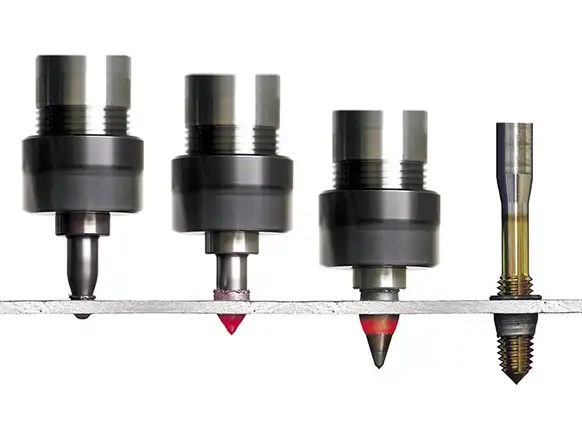
The Machine: Dual-Zone Pendulum + 4 Independent Spindles
| Parameter / Type | Specification / Status |
|---|---|
| Traditional single-zone, single-spindle CNC | Spindle waits while operator loads/unloads | 3–5 min per switch | ~60 sec / hole |
| DHM-4030DT: dual-zone, 4-spindle | Zero idle time | 0 sec switch | 15 sec / hole |
A strong thread is only half the output story. The other half is how little time the machine spends not cutting — and that comes entirely from the mechanical layout, not the thermal process.Dual-zone pendulum worktable: the table is split into a Left Zone and Right Zone. While the spindle assembly is machining tube in one zone, the operator is loading and unloading the other. The moment one zone finishes, the spindle assembly swings straight to the other — the spindle never sits idle waiting for a part change.4 independent spindles (2 thermal-drill + 2 roll-tap): instead of one spindle drilling, then indexing over to tap — and stopping to change tooling every time the spec changes — each zone gets its own dedicated drill-and-tap spindle pair. Two different hole/thread specs can run simultaneously, one per zone, with zero tool-change downtime between them.
Threading Strength: Flow-Formed vs Every Alternative
| Method | Strength & Performance |
|---|---|
| Flow-formed threading | 3× wall thickness, very high pull-out resistance, excellent vibration stability — thread is integral, nothing to loosen |
| Weld nut | Full nut height, high pull-out resistance, good vibration stability, but distortion risk |
| Rivet nut | Mechanical crimp, medium pull-out resistance, moderate vibration stability — loosens over time |
| Direct tap (thin wall) | 1× wall thickness, low pull-out resistance, poor vibration stability |
Direct tapping into a 1.5 mm wall gives barely one full thread. Flow-formed threading on the same wall gives 4–6 mm of engagement, on tube from 0.8–6 mm thick — because the collar is part of the tube itself, not a separate part that can weld-distort or vibrate loose.
Real Case: A Fitness Equipment Frame Manufacturer in Vietnam
Customer: A leading Vietnamese manufacturer of commercial fitness equipment — treadmills, power racks, elliptical machines.
Part: Square carbon steel tube frames, 1.5–3 mm wall thickness, two hole/thread specs running on the same line.
Before: Conventional Process
Manual drilling → chip cleanup → weld nut or rivet nut installation → inspection, across three stations and three skilled workers. Switching between the line's two specs cost 3–5 minutes of tooling changeover each time.
Machine Installed: DUOMI Solution
DHM-4030DT dual-zone, 4-spindle CNC drilling and threading machine.

Result: +210% output
| Metric | Before (Weld Nut) | After (Flow Drill) |
|---|---|---|
| Time / threaded hole | ~60 sec | 15 sec |
| Operators required | 3 skilled | 1 general operator |
| Tool-change downtime | 3–5 min per batch switch | 0 sec |
| Defect / rejection rate | 4.5% | < 0.1% |
| Item | Annual saving (USD) |
|---|---|
| Weld nut purchasing | ~$15,000 |
| Welding labor | ~$22,000 |
| Rework reduction | ~$9,000 |
| Changeover Time Recovered | ~$6,000 |
| Total Annual Savings | ≈ $52,000 / year |
Roughly half of that gain is the thermal thread itself removing the weld/rivet-nut station; the other half is the dual-zone, 4-spindle layout removing every minute of changeover and idle time between them.
This case reflects representative production economics for this part type, material, and volume; the customer's identity is withheld per confidentiality. We're glad to walk through the underlying numbers, or share verified data once we've run your specific part.
What This Machine Saves You
Any tube or sheet-metal frame currently using a weld nut, rivet nut, or direct tap loses the same two ways: weak or failure-prone threads, and idle/changeover time between parts and specs. This machine attacks both — the thermal process drops the fastener and the failure mode, and the dual-zone, 4-spindle layout drops the downtime. Applies directly to fitness equipment frames, automotive structural tubing, shelving and racking, HVAC duct frames, cable trays, and modular furniture.
→ View full DHM-4030DT specificationsTalk to Us About Your Pipe or Tube Part
Send your tube sample or CAD drawing — we'll run a free proof-of-concept test on your material and send back real cycle-time and thread-strength data before you commit to anything.
Send us your tube OD, wall thickness, thread size, how many specs run on your line, and monthly volume — our engineers will run the real cycle time calculation and savings comparison for your part.
Frequently Asked Questions
Key technical, production, and commercial considerations addressed by our engineering specialists.
What materials can be processed using the thermal friction drilling process?
It works on most ductile metals including carbon steel, stainless steel, aluminum, copper, brass, and galvanized steel. It is especially effective for thin-walled tubes (0.8mm–6mm) and sheet metal, but is not suitable for cast iron or hardened tool steel.
Does the dual-zone pendulum design require two operators?
No — one operator runs the entire cell. The pendulum layout enables continuous production: while the 4 spindles are actively thermal-drilling and roll-tapping in Zone A, the operator safely unloads and fixtures new tubes in Zone B. Once Zone A finishes, the machine immediately swings to Zone B with zero spindle idle time.
We run multiple hole/thread specs on our fitness frame line — does that slow down throughput?
Not with the DHM-4030DT's 4-spindle layout. Each zone features dedicated thermal-drilling and roll-tapping spindle pairs. Two distinct hole/thread specifications (e.g. M8 on one zone, M10 on the other) can run concurrently with zero tool-change downtime.
Can I test this on our proprietary tube profiles before committing?
Yes, 100% free of charge. Simply ship us your raw tube samples or send part CAD drawings with your thread specifications. Our tooling engineers will fixture your part, test-drill and roll-tap the collar, film unedited video footage, and express ship the finished parts back to your facility for torque and pull-out verification.
How is overseas technical support and commissioning handled?
Every DUOMI CNC machine ships fully assembled, factory pre-calibrated, and test-run with documentation. We provide bilingual English operation manuals, video wiring walkthroughs, and lifetime remote engineering support via WhatsApp/video call within 24 hours. Critical spare parts ship via international express within 1–3 business days.
Can the machine bed or stroke be customized for extra-long equipment frames?
Yes. In line with our engineering philosophy—'We Engineer The Machine Around Your Process'—we routinely build custom beds (X-travel up to 6,000mm), multi-spindle arrays, and pneumatic heavy-tube clamping systems tailored specifically to long fitness equipment tubes and rack posts.
DHM-4030DT Dual-Zone Flow Drill CNC Machine — Specifications
Click to Expand Full Technical Specifications (20)
| Model | DHM-4030DT Dual-Zone CNC Thermal Drilling & Tapping Machine |
| XYZ Machining Stroke | X 4000mm, Y 300mm, Z 200mm |
| Spindle Speed | 100 ~ 24,000 rpm (Servo controlled) |
| Spindle Configuration | 4 independent spindles (2 Drill + 2 Tap, dual-zone pendulum) |
| Spindle Taper Hole | ER20 |
| Spindle Power | 0.55 ~ 3.0 kW per spindle |
| X-Axis Rapid Traverse | 30 ~ 60 m/min |
| Y-Axis Rapid Traverse | 25 m/min |
| Z-Axis Rapid Traverse | 25 m/min |
| Borehole Diameter Range | Ø1 ~ 16 mm |
| Tapping Diameter Range | M2 ~ M14 |
| Chamfer Range | 1 ~ 20 mm |
| Tool Magazine | 4 Dedicated Spindles (Zero Tool-Change Time) |
| Repeat Positioning Accuracy | ±0.02 mm |
| Table Size | 4000mm × 280mm (Dual-Zone 2000mm × 2) |
| Programming Mode | CAD file import / computer programming / manual programming |
| System Program Storage Capacity | About 10,000 NC files |
| Operating Voltage | AC 220V / 380V, 50/60 Hz |
| Machine Weight | Approx. 2,600 KG |
| Floor Space | 5500mm × 1500mm × 1700mm |
Request a Free Proof-of-Concept Sample Machining & Cycle Time Report
Send us your tube specs and drawings. Our tooling engineers will fixture your part, test-drill & roll-tap the collar live, and return finished samples for verification — 100% Free, Zero Obligation.