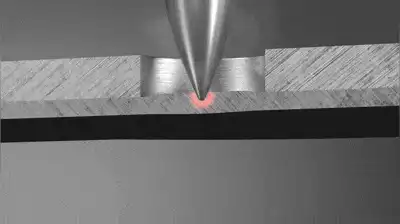
For thin-walled sheet metals, tubes, and hollow structural sections, tapping strong internal threads has historically presented significant engineering challenges. Traditional solutions—such as rivet nuts, press nuts, or welded blind nuts—add secondary assembly steps, increase material costs, and introduce failure points like rotation spun-out or weld degradation.
Thermal friction drilling (also referred to as flow drilling, form drilling, or friction drilling) offers a highly reliable, single-step alternative by using frictional heat to extrude an integral bushing directly from the base material.
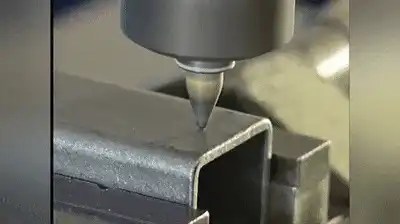 Figure 1: High-speed thermal friction drilling forming an extruded collar on a square steel tube.
Origin and Working Principle of Thermal Friction Drilling
Developed in Germany, thermal friction drilling is a chipless thermal-mechanical forming process designed to create high-integrity threaded collars in thin metal profiles in under 6 seconds.
The Thermal-Mechanical Physics Behind Flow Drilling
- Frictional Heat Generation: A specialized conical tool made of solid tungsten carbide (WC-Co) rotates at high spindle speeds (1,500 to 4,000 RPM) and contacts the metal workpiece under controlled axial axial force.
- Material Softening: Frictional heat rapidly raises the localized metal temperature to 600°C–800°C (below the material's melting point), temporarily plasticizing the metal.
- Bushing Extrusion: As the tool advances, it displaces the softened material axially both upward and downward. This creates a cylindrical sleeve or collar (bushing) with a wall thickness up to 3 times the original material thickness.
- Cold-Form Tapping: A cold-forming tap (roll tap) is then driven into the newly formed bushing to produce continuous, grain-flow-aligned internal threads without producing metal chips.
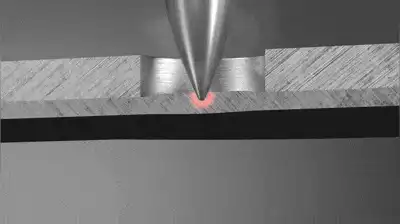 Figure 2: Cycle demonstration showing metal displacement and sleeve formation.
Key Process Parameters & Technical Specifications
To achieve optimal thread engagement depth (compliant with ISO/DIN thread standards) and tool life, specific CNC parameters must be maintained:
| Process Parameter | Technical Standard / Range |
|---|---|
| Workpiece Thickness | 0.8 mm – 12.0 mm |
| Spindle Speed (RPM) | 1,500 – 4,000 RPM (depends on drill bit diameter) |
| Localized Temperature | 600°C – 800°C |
| Cycle Time | 2 – 6 seconds per hole |
| Tool Material | Micro-grain Solid Tungsten Carbide |
| Extruded Sleeve Length | 2.5x to 3x base metal wall thickness |
| Threading Method | Chipless Cold Roll Tapping (Form Tapping) |
Major Advantages of Thermal Friction Drilling
Thermal friction drilling technology provides structural, economic, and manufacturing advantages over standard mechanical fasteners:
1. Chipless Metal Forming
Because the process relies on plastic deformation rather than cutting, zero swarf or metal chips are generated inside sealed tubes or hollow assemblies. This eliminates internal contamination in hydraulic, HVAC, and pneumatic lines.
2. Enhanced Grain Structure & Mechanical Strength
As the material undergoes friction-induced heating followed by controlled ambient air cooling, the extruded zone experiences an effect similar to localized normalizing heat treatment. The uninterrupted material grain flow results in: * Higher Pull-out Strength: Exceeds standard rivet nut retention by up to 50%. * Superior Torque Resistance: Eliminates spun-out failures common in press-fit hardware. * Increased Load Capacity: Supports high-tension bolt connections even in 1 mm to 2 mm wall profiles.
3. Streamlined Production and Lower Cost
- Eliminates Hardware Inventory: No need to purchase, store, or feed press nuts, insert rivets, or weld fittings.
- Rapid Cycle Times: Total hole forming and thread creation takes 2 to 6 seconds.
- Automation Ready: Can be fully integrated into multi-axis CNC thermal friction drill-mill-tap centers.
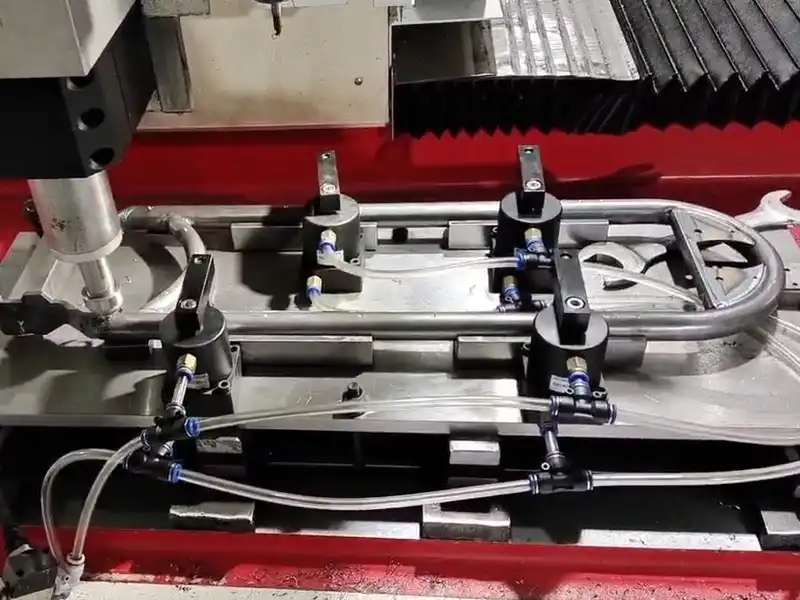
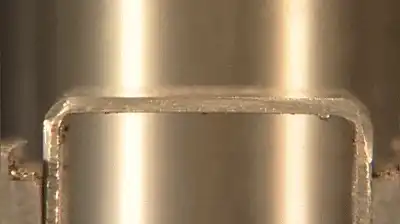 Figure 3: Multi-axis CNC drill, mill, and tap machine optimized for high-speed thermal friction drilling.
Material Compatibility
Thermal friction drilling operates successfully across a broad spectrum of ferrous and non-ferrous ductile metals, including:
- Low-Carbon & Mild Steels: S235, S355, AISI 1018, Q235
- Stainless Steels: AISI 304, AISI 316, AISI 430
- Aluminum Alloys: 6061-T6, 6063, 5052, 7075
- Copper, Brass, & Bronzes: High-conductivity copper alloys
- Titanium Alloys: Grade 2, Grade 5
It is also suitable for plated, galvanized, or pre-coated tubing, making it highly versatile for structural frame manufacturing.
Typical Industry Applications
- Automotive & EV Chassis: Battery frame structures, crash bars, and seat rails.
- Fitness Equipment: Heavy-duty structural tubing connections for commercial gym machinery.
- HVAC & Fluid Transport: Copper and brass manifold pipe branching without brazed fittings.
- Motorcycle & Bicycle Frames: Lightweight aluminum alloy frame mountings.
- Architectural Hardware: Stainless steel handrails, balustrades, and structural glass fittings.
Need High-Efficiency CNC Drilling & Tapping Machinery?
Consult with our senior application engineers to get a custom cycle time simulation and tailored machine proposal within 24 hours.